


I'm a community builder focused on growing the global Java and Jakarta EE ecosystems. I specialise in community strategy, open source engagement and developer-focused technical marketing, building strong and collaborative...
Learn More I'm a community builder focused on growing the global Java and Jakarta EE ecosystems. I specialise in community strategy, open source engagement and developer-focused technical marketing, building strong and collaborative...
Learn More I'm a community builder focused on growing the global Java and Jakarta EE ecosystems. I specialise in community strategy, open source engagement and developer-focused technical marketing, building strong and collaborative...
Learn More


A N M Bazlur Rahman is a Software Engineer with over a decade of specialized experience in Java and related technologies. His expertise has been formally recognized through the prestigious...
Learn MoreRecent comments
A N M Bazlur Rahman
How to Share Your Work...On average, how much time does it usually take to create a video or podcast?
All 41 Likes
-
 Foojay Podcast #94: More Than a Blog: How...
Dominika Tasarz
• 1 month ago -
-
-
 Foojay Podcast #92: Java 26 Is Here: What’s...
Frank Delporte
• 3 months ago

The OpenJDK sources are now fully available and developed on GitHub as a result of Project Skara. Thanks to a lot of work done by the community, the full Java development flow has been migrated to GitHub while keeping the repository history. This process has been described on the GitHub blog.
This also means we are now able to build OpenJDK ourselves from the latest sources, very easily, on any device where we want to use the latest not-yet-released-version.
A micro SD card is the default way to add an operating system to the Raspberry Pi. But there is an alternative approach that you need to consider if you want to make your system more reliable. SD cards are not super fast and can get quickly corrupted when you are writing a lot to disc.
Switching from SD to USB Boot is very easy if you have a Flash Drive which is supported and the read speed is a lot higher! Combined with the higher reliability, this makes the switch a go go go…
In this article we present you with another great example of Java on Raspberry Pi. It shows how to create a Micronaut Velocity demo using an 8×8 LED matrix display.
Both on hardware as software level, you have different possible approaches, but the result is the same… a fun project to learn new software technologies and getting introduced into electronics.

The “Hello World” version of electronics programming is a blinking LED. But, in this post, we will go a few steps further and control 8 LEDs inside a number display.
Igor De Souza, Dublin based Principal Big Data Consultant at Oracle, set up an interesting experiment in which he combines a LED number display with the Raspberry Pi and Quarkus.
Thanks to Twitter and LinkedIn, I’ve been in touch with several developers who are doing cool Java stuff on the Raspberry Pi.
Here I want to share those projects with you, as they can be an inspiration for all of us to get started with Java development on the Raspberry Pi!
With Azul Zulu OpenJDK 15, for this post I did some experiments with Java 15, reusing the Ubuntu 64bit SD card which was also used for my earlier post “Startup Speed of Spring and Quarkus JARs on the Raspberry Pi”.
Do you need to switch from OpenJDK 11 to 15? No, not really, based on these results. But each new version has bug and security fixes, new features, and generic improvements!
For my book “Getting Started with Java on Raspberry Pi”, an example was described to store sensors and measurements in an H2-database through REST APIs with a Spring application on the Raspberry Pi.
The application takes some time to start on a Raspberry Pi, and Adam Bien who does the airhacks.fm podcast, asked me if I could compare this to a similar Quarkus application, which resulted in some nice results.
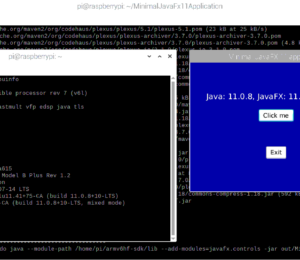
In a previous post “Installing Java and JavaFX on the Raspberry Pi”, you can read how to install BellSoft LibericaJDK to be able to run JavaFX applications with a graphical user interface on a Raspberry Pi with ARMv7 or ARMv8 processor.
For (older) versions of the Raspberry Pi that use an ARMv6 processor, special instructions are needed!
One of the most read articles on my blog is about the installation of a recent Java on Raspberry Pi (March 13, 2019).
Disclaimer: this article is only valid for Raspberry Pi’s with an ARMv7 or ARMv8 processor. In the Raspberry Pi specifications table on Wikipedia, you get a clear overview of the Pi-types with this processor:
– Model A+, version 3
– Model B, version 2, 3 and 4
– Compute Module, version 3

If you want to know what I spoke about in @jcon_conference in Germany, here's an interview I did at the @foojayio podcast:
#Java #JCON #JakartaEE #AI #A2A

Our team loves to meet and talk with the Java community from around the world. If you want to learn more. You can find all OmniFish presentations at: https://speakerdeck.com/omnifish, including links to the source code of related demos. Or get in touch for a free consultation call.
Another happy customer :)
"Their expertise and flexible hands-on troubleshooting support accelerated resolution of several unexpected hurdles and ultimately got us to a successful upgrade outcome."
If you would like to discuss how we could help your company, get in touch.


All 71 Comments
A N M Bazlur Rahman
• 3 years agoOn average, how much time does it usually take to create a video or podcast?